Talk Program Series 08
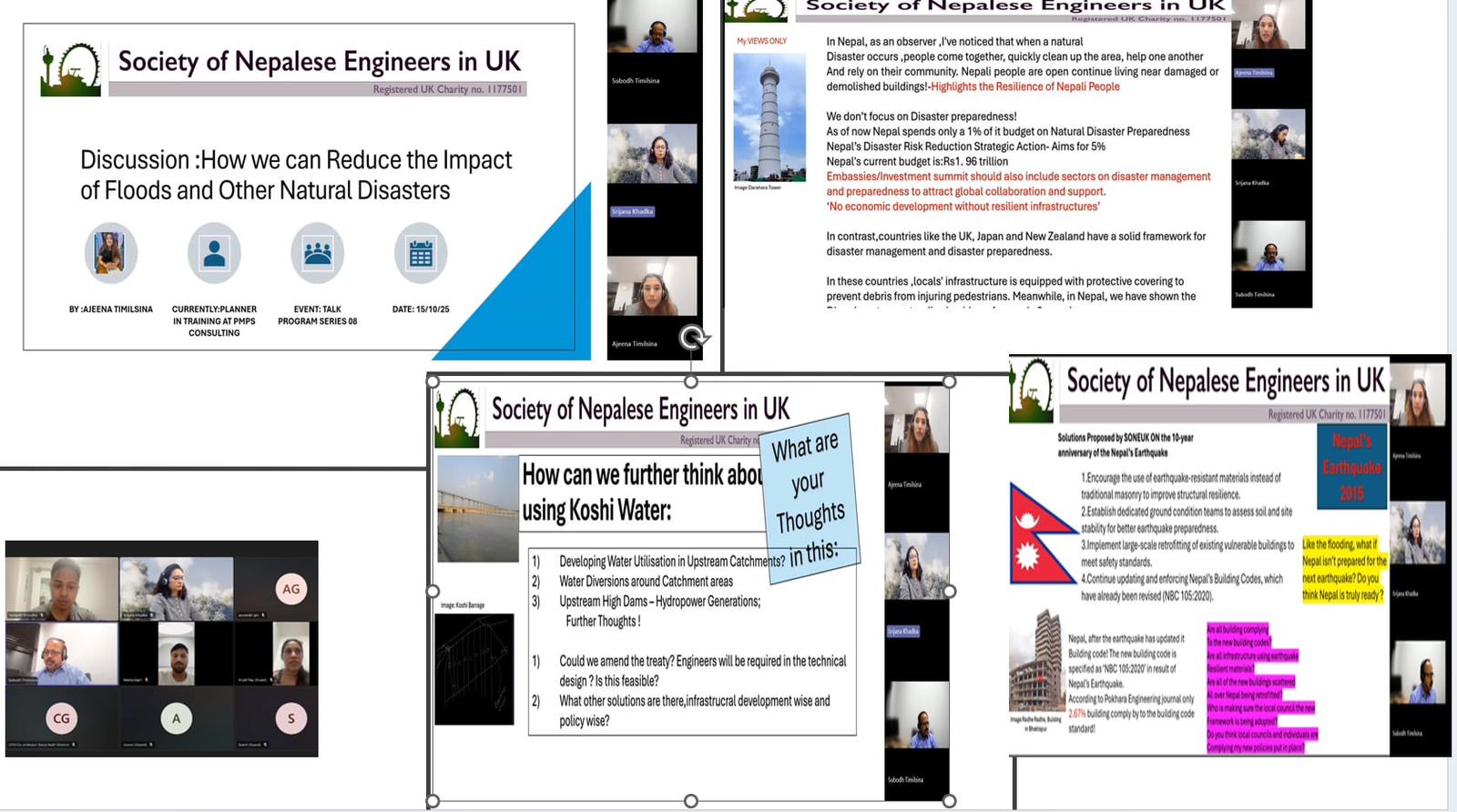 On October 15, 2025, the Society of Nepalese Engineers in the UK (SONEUK) hosted its eighth Talk Programme, titled "How Nepal Can Build a Safer Future After Disasters: With a Focus on Flood Resilience." The event, moderated by Er. Srijana Khadka, centered on a research presentation by Er. Ajeena Timilsina regarding Nepal’s disaster trends and vulnerability.
Identifying the Crisis: Trends and Data
Ajeena provided a sobering look at the human cost of flooding in Nepal over recent years, citing data that underscores the urgency of the issue:
-
Casualties: 205 deaths in 2022, 104 in 2023, and 224 in 2024.
-
Fiscal Gap: Ajeena noted that Nepal allocates only about 1% of its national budget to disaster preparedness—a sharp contrast to the proactive investment strategies seen in the UK, Japan, and New Zealand.
Strategies for a Resilient Future
The discussion pivoted from identifying risks to proposing actionable, engineering-led solutions. Ajeena advocated for a shift from reactive recovery to proactive mitigation through:
-
Infrastructure & Planning: Upgrading sewage systems, enforcing strict zoning laws, building flood defenses, and using eco-friendly construction materials.
-
Nature-Based Solutions: Extensive tree planting and the restoration of natural drainage.
-
Technology & Education: Implementing AI for flood forecasting, strengthening early warning systems, and introducing "Monsoon Awareness Weeks" or disaster drills into school curricula.
The Role of the Diaspora
A key highlight of the talk was the potential for SONEUK to act as a technical bridge. Ajeena emphasized that UK-based engineers can contribute significantly through:
-
Capacity Building: Sharing technical expertise and research with Nepali institutions.
-
Institutional Coordination: Strengthening ties with the National Disaster Risk Reduction and Management Authority (NDRRMA).
-
Academic Collaboration: Partnering with universities to modernize disaster management strategies.
The event concluded with an open forum, reinforcing the idea that while natural disasters are inevitable, their impact can be drastically mitigated through adaptive policies, resilient infrastructure, and informed community preparedness.
More Past Events